

 Complete Pokémon Go Dynamax Guide: Rules, Capture & Max Moves
category:Pokemon GO
Jun-04-2026 Source: PKMBUY
Dynamax originally debuted as a flagship battle mechanic on Nintendo Switch’s Pokémon Sword and Shield, before making its long-awaited five-year transition into Pokémon Go. Once activated in combat, affected Pokémon balloon into towering giants surrounded by floating cloud particles, alongside exclusive Max Move skills that reshape raid combat strategies.
This guide covers everything you need to know:
-
In-battle activation logic
-
All viable Dynamax Pokémon farming routes
-
Full upgrade cost table for Max Moves
-
Sorted official Dynamax Pokédex
-
Key differences between Dynamax and Gigantamax
Note on game updates
Pokémon Go mechanics and availability may change over time. This guide reflects the current general rules as of the latest major Dynamax release.

What Is Dynamax & Step-by-Step Transformation Rules
Dynamax transformation is strictly limited to Power Spot-linked Max Battles. You cannot trigger it during wild encounters or standard Gym matches.
Activation workflow:
-
Join a Max Battle against a Power Spot boss. Every Fast Attack and Charged Attack fills the Max Meter at the bottom of the screen. Moving your active Pokémon also adds small gauge energy.
-
When the Max Meter is full, a short selection window appears. Pick any alive Pokémon to switch into Dynamax form. This is also your best chance to swap in type-advantage counters.
-
Dynamax lasts exactly 3 turns. You can use one Max Move per turn. Every Dynamax Pokémon has three unique Max Moves, but only the offensive Max Strike is unlocked by default — defensive and healing skills require resources.
-
If you skip manual skill selection, the game automatically uses Max Strike after a short countdown.
-
After 3 turns, the Pokémon shrinks back. You must refill the Max Meter from zero to Dynamax again.
Pro Tip
Always check the raid boss’s moveset before using Dynamax.
Max Guard (damage reduction) or Max Spirit (team healing) often outperforms pure offense against high-damage bosses.
Four Valid Methods to Obtain Dynamax Pokémon
Clearing Max Battle bosses acts as the primary mainstream way to collect oversized Dynamax Pokémon, while three supplementary free farming paths help novice players obtain their first raid-qualified Dynamax creature to join future raid matches. All obtained Dynamax Pokémon follow canonical evolutionary chains just like ordinary wild Pokémon.
2.1 Core Raid Capture Route
After defeating a one-star Power Spot Boss, players receive 10 default Premier Balls for capture attempts; spending 200 Poké Coins can increase your available catching balls on the reward page. Once all Premier Balls run out without successful capture, the Dynamax boss flees permanently, forcing players to start a brand-new Max Battle for another catching opportunity. There is a small random chance of getting shiny variant Dynamax Pokémon as post-victory raid drops.
2.2 Limited Special Research Reward
Complete all tasks from the “To the Max!” Special Research event line, and trainers get permanent free Dynamax Wooloo and Dynamax Skwovet with zero extra in-game costs.
2.3 Max Particle Accumulation Reward
Gather a total of 1,000 Max Particles to claim a complimentary Dynamax Wooloo. The most efficient farming shortcut is collecting 700 Particles via repeated Max Battle clears, then finishing a 2km walking task to earn the remaining 300 required Particles.
2.4 Ultra-Rare Wild Overworld Spawn
Dynamax Pokémon spawn sporadically in open wild terrain near overworld Power Spot markers, yet their spawn rate stays extremely low, making this approach unreliable for consistent stable farming.
Important Reminder: Certain evolved species such as Dubwool never spawn naturally from raids or wild maps; users can only gain these Pokémon by evolving their pre-evolved Dynamax forms or trading with other in-game trainers. The official developer will roll out new Dynamax Pokémon regularly through upcoming seasonal limited-time events.
Full Cost Table for Unlocking & Levelling Three Types of Max Moves
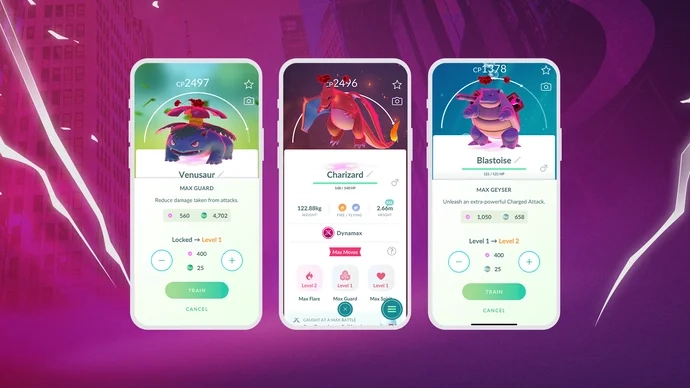
Each Dynamax Pokémon gains access to three unique Max Moves after transforming, covering offensive damage output, incoming damage reduction and team HP recovery respectively. Only the native attacking Max Strike unlocks instantly upon catching the Pokémon, while Max Guard and Max Spirit need resource investment to unlock and upgrade. Every single unlock or level-up action rewards bonus trainer XP.
| Max Move | Core Function | Unlock Condition |
| Max Strike | Attribute-scaled damage | Auto-unlocked after capture |
| Max Guard | Reduce incoming damage | Resource-locked |
| Max Spirit | Restore HP for all surviving team members | Resource-locked |
Standard Resource Consumption Rules
- Unlock single locked skill (Max Guard/Max Spirit): 400 Max Particles plus 50 pieces of that Pokémon’s exclusive Candy; unlocking both sealed skills costs 800 Max Particles +100 Candy total, with 4000 XP rewarded per individual skill unlock.
- Level 1 → Level 2 upgrade for any Max Move: 600 Max Particles +100 regular Candy of the target Pokémon, rewarded with 6000 XP after each successful upgrade.
- Level 2 → Level 3 maximum-tier final upgrade: 800 Max Particles +40 XL Candy of the relevant Pokémon, another 6000 XP upon finishing final enhancement.
All three Max Moves share identical upgrade pricing rules, starting from Level 1 and requiring two rounds of upgrades to hit maximum Level 3 cap.
Complete Released Dynamax Pokémon List (Sorted by Pokédex Number)
Split into three regional catalogs for tidy browsing, formatted with Dex No., English Name & Type Attributes separately:
Kanto Region
| Dex No. | Pokémon | Type |
| 1 | Bulbasaur | Grass/Poison |
| 2 | Ivysaur | Grass/Poison |
| 3 | Venusaur | Grass/Poison |
| 4 | Charmander | Fire |
| 5 | Charmeleon | Fire |
| 6 | Charizard | Fire/Flying |
| 7 | Squirtle | Water |
| 8 | Wartortle | Water |
| 9 | Blastoise | Water |
| 10 | Caterpie | Bug |
| 11 | Metapod | Bug |
| 12 | Butterfree | Bug/Flying |
| 13 | Pidgey | Normal/Flying |
| 14 | Pidgeotto | Normal/Flying |
| 15 | Pidgeot | Normal/Flying |
| 25 | Pikachu | Electric |
| 26 | Raichu | Electric |
| 58 | Growlithe | Fire |
| 59 | Arcanine | Fire |
| 63 | Abra | Psychic |
| 64 | Kadabra | Psychic |
| 65 | Alakazam | Psychic |
| 66 | Machop | Fighting |
| 67 | Machoke | Fighting |
| 68 | Machamp | Fighting |
| 92 | Gastly | Ghost/Poison |
| 93 | Haunter | Ghost/Poison |
| 94 | Gengar | Ghost/Poison |
| 98 | Krabby | Water |
| 99 | Kingler | Water |
| 106 | Hitmonlee | Fighting |
| 107 | Hitmonchan | Fighting |
| 113 | Chansey | Normal |
| 125 | Electabuzz | Electric |
| 133 | Eevee | Normal |
| 134 | Vaporeon | Water |
| 135 | Jolteon | Electric |
| 136 | Flareon | Fire |
| 138 | Omanyte | Rock/Water |
| 139 | Omastar | Rock/Water |
| 140 | Kabuto | Rock/Water |
| 141 | Kabutops | Rock/Water |
| 144 | Articuno | Ice/Flying |
| 145 | Zapdos | Electric/Flying |
| 146 | Moltres | Fire/Flying |
Johto Region
| Dex No. | Pokemon | Type |
| 196 | Espeon | Psychic |
| 197 | Umbreon | Dark |
| 243 | Raikou | Electric |
| 244 | Entei | Fire |
| 245 | Suicune | Water |
| 249 | Lugia | Psychic/Flying |
| 250 | Ho-Oh | Fire/Flying |
Hoenn, Unova & Kalos (Selected)
| Dex No. | Pokemon | Type |
| 357 | Tropius | Grass/Flying |
| 374 | Beldum | Steel/Psychic |
| 375 | Metang | Steel/Psychic |
| 376 | Metagross | Steel/Psychic |
| 415 | Combee | Bug/Flying |
| 416 | Vespiquen | Bug/Flying |
| 470 | Leafeon | Grass |
| 471 | Glaceon | Ice |
| 475 | Gallade | Psychic/Fighting |
| 519 | Pidove | Normal/Flying |
| 520 | Tranquill | Normal/Flying |
| 521 | Unfezant | Normal/Flying |
| 524 | Roggenrola | Rock |
| 525 | Boldore | Rock |
| 526 | Gigalith | Rock |
| 527 | Woobat | Psychic/Flying |
| 528 | Swoobat | Psychic/Flying |
| 529 | Drilbur | Ground |
| 530 | Excadrill | Ground/Steel |
| 546 | Cottonee | Grass/Fairy |
| 547 | Whimsicott | Grass/Fairy |
| 584 | Vanillite | Ice |
| 585 | Vanillish | Ice |
| 586 | Vanilluxe | Ice |
| 593 | Jellicent | Water/Ghost |
| 689 | Binacle | Rock/Water |
| 690 | Barbaracle | Rock/Water |
| 702 | Dedenne | Electric/Fairy |
| 759 | Stufful | Normal/Fighting |
| 760 | Bewear | Normal/Fighting |
| 788 | Tapu Bulu | Grass/Fairy |
Core Differences Between Regular Dynamax and Gigantamax Forms
Gigantamax stands as a rare exclusive branch variant derived from basic Dynamax transformation; both mechanics originate from Generation 8 Sword & Shield settings and are fully available inside current Pokémon Go server, with obvious gaps in appearance and in-battle performance:
- Visual Difference: Standard Dynamax only enlarges a Pokémon’s body size without altering its original artwork design, while Gigantamax creatures receive full unique model remodels, like the iconic retro chubby 90s Pikachu and elongated-body Meowth. Statistically, merely 32 Pokémon evolutionary lines own available Gigantamax potential, which totals 33 distinct in-game appearances because Urshifu’s Single Strike and Rapid Strike variants each feature an independent exclusive Gigantamax design.
- Combat Distinction: All Gigantamax Pokémon replace their default Max Strike with exclusive species-locked G-Max signature moves that ordinary Dynamax specimens cannot learn, granting unique tactical advantages against high-difficulty raid bosses.
- Acquisition Rarity: Gigantamax spawn probability during Max Battle matches is drastically lower than common Dynamax variants, making these rare forms highly sought-after premium collectibles for completion-focused and competitive trainers.
Closing Strategy Tip
Keep an eye on official in-game event notifications for upcoming newly added Dynamax Pokémon batches. Mastering the complete set of Dynamax rules helps players cut down unnecessary waste on Candy and Max Particles, letting you build high-tier competitive Dynamax teams efficiently for all future endgame Max Battle challenges.


